‘Technical implementation of DROPS’
 Photo by Vitaly Gariev on Unsplash
The DROPS project is coming to an end, and it is time to report on the technical implementation. To this end, the technical architecture of the DROPS platform will first be described, followed by a more detailed presentation of individual components. There is also a video that illustrates the individual aspects of the demonstrator using an example.
Overview of the architecture
Data intake
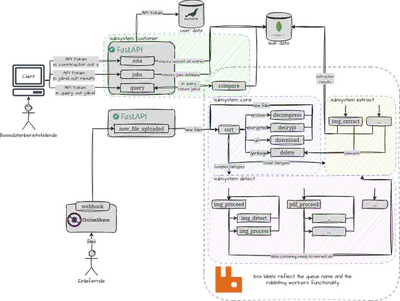
The DROPS platform is implemented as a client-server application. Submitters, such as security researchers or whistleblowers, access the website to upload data via their browser. They have the option of connecting via an https connection (standard encryption) or via TOR/Onion Network in order to remain as anonymous as possible. The existing Onionshare project is used for this part, which also facilitates the submission of data.
Data analysis
Submitted files are then subjected to a multi-stage verification process. They are sorted, decrypted or decompressed if necessary, and categorised according to whether they contain the desired data. Unwanted data is deleted immediately. The current technical demonstrator processes image and PDF files that may contain either identity documents (currently identity cards from the Federal Republic of Germany) or invoices. These are then recognised and processed separately by a queue and worker system.
After processing the raw files, optimised vLLMs are then used to recognise the actual text data. These are hashed with argon2id, using specific, predefined anchor points. These anchor points consist, for example, of the name, address and date of birth. This serves to ensure data security, as even the hashed data cannot simply be iterated through.
Data matching
The processed data is then stored as securely and restrictively as possible to ensure maximum data protection, while still allowing data owners or basic data providers to match data. To this end, the generated hashes are truncated to achieve greater anonymity.
Video demonstration
The technical implementation is explained in the video below, which guides you through the input masks. The technical procedures used are also explained schematically.